

Capacity and reach of a crane truck: how to pick the right unit for each lift
Weight and reach: two figures that must be read together
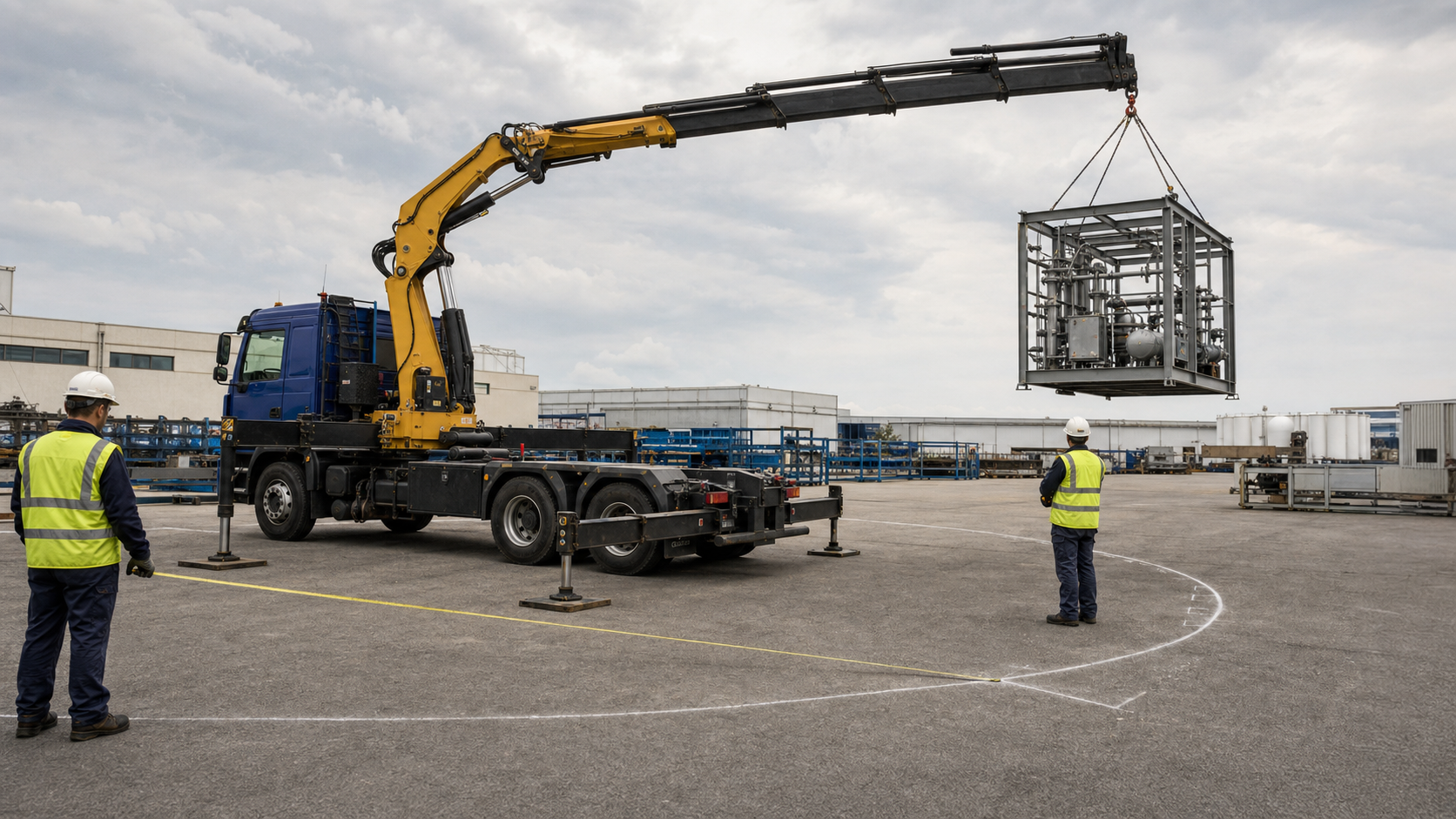
When someone asks us for a crane truck, the first number we usually get is the weight. That is not enough on its own. The crane has a nominal capacity that applies under specific conditions, and those conditions change from one lift to the next. The choice depends on weight and reach together: a truck may handle a load close to the vehicle but not at a longer radius.
That is why, on the first call, we ask for both figures together. If one is missing, we have a number, not a decision.
Why a crane does not lift the same at three metres as at fifteen
Working reach is the horizontal distance from the centre of the crane to the load, with the boom extended in the working position. The further the radius, the lower the useful capacity: the load moment the boom can take drops. The free height above the load and the boom’s own deflection also play a role.
The same load can require two different crane trucks depending on where it sits: on a warehouse floor, halfway up a rooftop, or cantilevered over a façade. Talking about “the truck’s capacity” as a flat figure does not work.
The data that changes which truck gets assigned
Beyond the weight-reach pair, several other details knock the obvious choice down:
- Real dimensions of the load (length, width, height) and, if the load is asymmetric, where the centre of gravity sits.
- Planned lifting points: lifting eyes, certified shackles, or textile slings. If they do not exist, we define them with the client.
- Access to the pickup and the drop-off points: street width, warehouse doors, clearance, gradients, tight bends.
- Obstacles in the vertical path of the lift: overhead lines, canopies, branches, balconies.
- Room for the outriggers: in many urban areas the four jacks do not fit in parallel and the position has to be worked out.
- Ground type: asphalt, cobblestone, indoor slab, compacted earth. On soft ground, spreader plates are needed.
- Overhead lines or an overhanging façade that force the load to be lifted with a single boom swing.
Access, outriggers and working space
The access phase is the part of the work that does not show in photos. The truck has to drive in, position itself and open the outriggers in a stable spot that still allows the boom to work. In Barcelona and the surrounding industrial belt, that kind of constraint usually limits more than the load weight.
When the client sends a plan or a photo of the site, the things we look at first are:
- Clear street width and the height of awnings or portals.
- Distance between the façade and the spot where the truck can park.
- Outrigger pad points and the spacing between them.
- Any overhead lines, traffic lights, canopies or cabling the boom could touch while slewing.
If the lift requires closing half the street or requesting a permit from the council, that is dealt with before the vehicle is confirmed, because it affects scheduling and cost.
Three practical selection cases
These examples show how the data above is applied.
HVAC unit on a rooftop. An outdoor unit has to reach a rooftop from a narrow street. Although the weight may look manageable, the reach, clear height and available outrigger space can rule out smaller vehicles. If the lift affects the carriageway, the date depends on coordination with the building and any required permits.
Industrial machine at the warehouse door. A machining centre enters through the door and has to be left beside a prepared base. Here the reach is short and the priority is lifting capacity close to the crane’s axis, together with the actual space available for the outriggers.
Bulky module in a yard. A long module has to clear a fence before being placed inside a yard. The obstacle increases the working radius, and the lifting points must follow the manufacturer’s instructions to avoid deforming the structure. Here the geometry can be more restrictive than the weight.
What to send us to get an accurate quote
Before asking for a quote, put together the following information:
- Weight and dimensions of the load, plus a recent photo.
- Planned lifting point, or a note saying there is none.
- Exact address for pickup and drop-off, with a plan or photo of the surroundings.
- Distance and obstacles between the truck and the final position of the load.
- Date and time window you have in mind, and any building or public-road restrictions.
- Site contact person and phone number.
With those details, the quote stops being indicative and gets close to the actual cost. Without them, the number always comes with a caveat.
Frequently asked questions
Can the same crane handle all my lifts?
No. The useful capacity changes with reach and height, so a short lift accepts one vehicle and a long one may rule it out.
Can you come and see the load before quoting?
Yes. That is the most reliable option when the lift is unusual. For standard operations the information above is usually enough.
Can the truck be confirmed from the weight alone?
No. Reach, height, access and outrigger space also need to be reviewed. If something does not fit, another setup has to be considered.
Do you work weekends or at night?
Yes, as long as local regulations and the conditions on site allow it. This is coordinated in advance.
Does the service include the operator and rigging?
This should be stated in the quote. It is also worth confirming which lifting accessories the load requires and who will supply them.
How to contact us
Send us the details from the section above so the crane truck setup can be reviewed. If there are several access points or obstacles, include photographs or a plan; that makes it easier to decide whether the site needs to be inspected before the quote is closed.
More information on our crane services and transport services. To discuss your case: contact.