

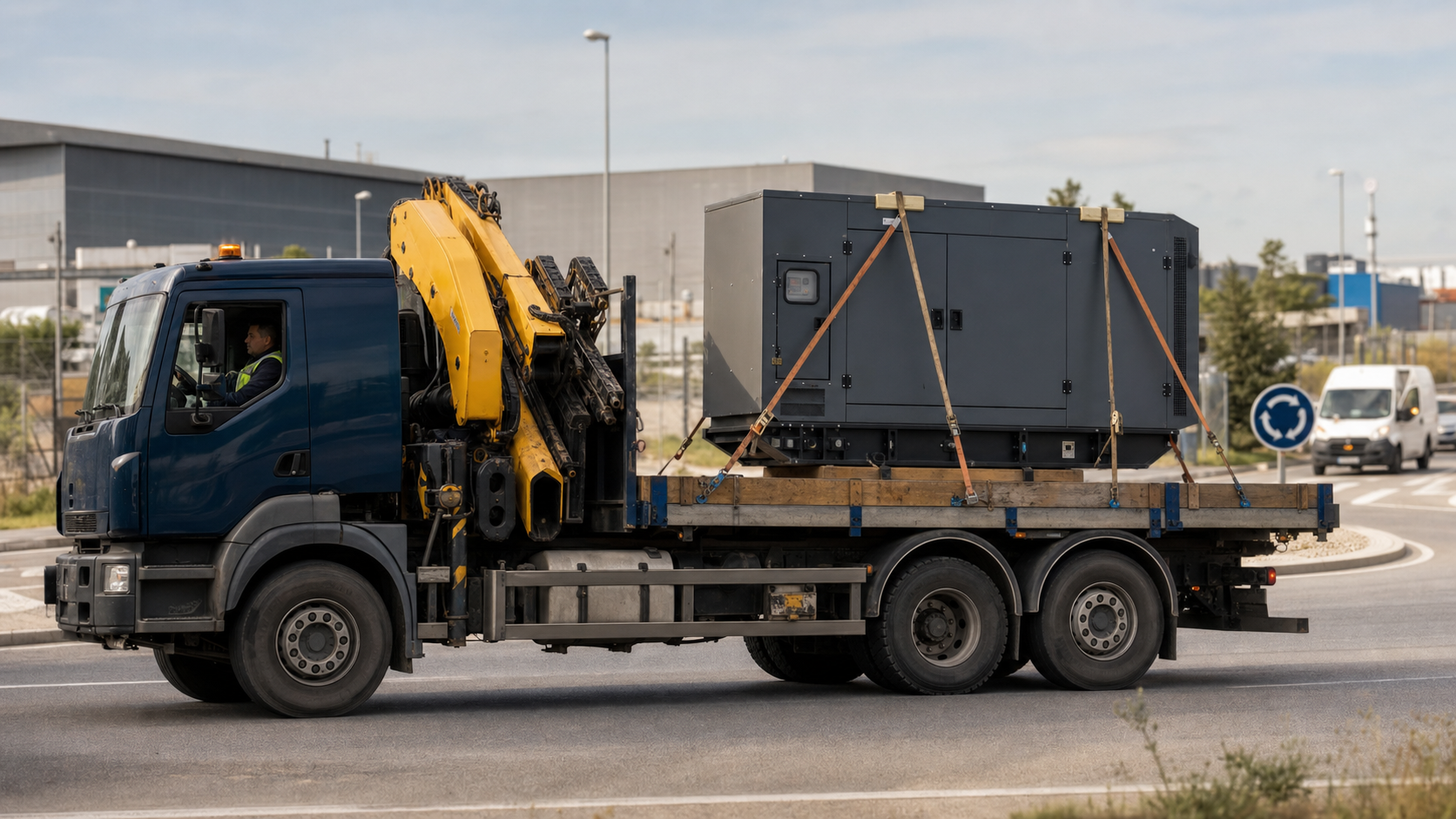
Transport of generator sets and auxiliary equipment with a crane truck: from pickup to final position
What changes when the service ends at the final position
There are two ways to contract this work. One is to bring the equipment to the customer’s door and unload it on the kerb. The other is to deliver it placed where it has to run, with the base, the anchors and the alignment already defined. The difference looks small, but it changes the provider you need: in the second case the crane truck has to think like an installer, not just a haulier.
In practice that means:
- Pickup at the customer’s yard, a warehouse or a rental company.
- Road transport with the load lashed and protected.
- Unloading on site and, where needed, positioning on a base, anti-vibration mount or prepared recess.
- Fine positioning (swing, reverse, alignment) so the installer or electrician takes over without having to move the unit by hand.
Equipment that usually needs transport and a crane
These are some of the units that commonly require transport and crane unloading:
- Diesel or gas generator sets.
- Job-site compressors and industrial compressors.
- Diesel tanks, water tanks and auxiliary tanks.
- Electrical panels and power cabinets.
- Support equipment for events: HVAC units, sound units, auxiliary generators.
- Continuity equipment for data centres and hospitals.
Each type has its own handling requirements. A canopied generator set is not handled like a compact compressor, and a tank calls for different supports and lifting points from an electrical cabinet. Every lift is therefore reviewed against the equipment documentation.
Before loading: weight, dimensions and lifting points
The loading phase is the one that demands the most information, and the one that saves the most headaches if it is prepared well. Here is what we ask for before sending a vehicle:
- Weight in running order and external dimensions, with a photo of the unit and, if available, of the data plate.
- Factory lifting points: eyes, lifting lugs, forklift pocket. If the unit has none, we work them out before we go.
- Centre of gravity, especially on skid-mounted generator sets and on tanks with an asymmetric base.
- Access to the pickup point: door width, portal height, ground that the truck can drive on.
- Documentation for the unit: delivery note, data sheet, manufacturer instructions for lifting and lashing.
If any of these data points is missing, we prefer to stop and discuss it with the customer before the truck arrives on site. Once the lift has started, improvising is expensive.
On the road: access, schedules and equipment protection
During transport three things are looked after at the same time:
- Load lashing. The load is lashed with certified straps and, where the unit requires it, with chocks and edge protectors. On generator sets with a soundproof canopy, the support points are checked so the panel is not marked.
- Schedules. Some destinations (hospitals, data centres, industrial plants) only accept loading and unloading in specific windows. The route is planned to arrive within that window.
- Permits and routes. For urban access or industrial estates with low clearance, the route is checked in advance. If the operation requires a council permit or a street cut, it is arranged before the date.
Proper protection of the equipment on the road prevents it from arriving with marks, vibration loosening or loose bolts. Each unit has its own way of being protected, and that is not the same for a generator set as for a tank.
On site: unloading, slewing and placement
Unloading is where the crane truck brings something different from a conventional haulier. The order is:
- Stabilise the truck with the outriggers in the planned position.
- Bring the load close to the final position without touching the façade, overhead lines or obstacles.
- Lower the load with the boom and, if needed, slew it in the air to point the exhaust side, the connections or the control panel in the planned direction.
- Place the load on the base, the anti-vibration mounts or the prepared recess, with the alignment requested by the customer.
- Release the hoist and pull the truck out once the load is resting and stable.
From there, the electrical connection, the panel wiring, the commissioning and the legalisation are done by the customer’s installer or electrician. We do not do that work: the crane places the unit where it goes, and the specialist connects it.
Cases in industry, construction and events
A short selection to show the range of situations:
Industrial maintenance. A replacement generator set has to enter a plant without disrupting operations. The lift is coordinated with the maintenance lead and the installer, who handles the connections and commissioning.
Construction site. A compressor has to reach an upper floor of a building under construction. The crane truck lifts it onto the platform prepared by the contractor, after the weight, working radius and support area have been confirmed with the site team.
Events. For an outdoor concert, several pieces of auxiliary equipment are moved: generators, HVAC units and distribution panels. The sequence is planned with the event production so each unit arrives at its time and the trucks do not crowd the same spot.
Continuity of operations. At a data centre, a backup generator set is replaced by a newer one. The lift is done at the weekend to avoid affecting the service, and it is coordinated with the power supplier and with the customer’s technical team.
What to include in the quote request
For the quote to cover the full lift and not just the transport, we ask for:
- Type of equipment, make and model, or at least weight and dimensions.
- Exact pickup and drop-off address, with a plan or photo.
- Planned final position: base, anti-vibration mounts, prepared recess, or kerb.
- Need for slewing in the air or for fine positioning.
- Date, time and, if applicable, a restricted unloading window.
- Required permits: loading zone, street cut, council authorisation.
- Site contact person and phone number.
If the lift is complex, we go on a site visit before confirming the vehicle. That is judged on a case-by-case basis.
Frequently asked questions
Can you do transport and placement in the same service?
Yes. That is the usual setup when the equipment cannot be left on the kerb or the installer has no means to move it.
Do you connect the unit, or do you leave it ready for someone else to connect it?
We leave it placed in its final position. The electrical connection, the commissioning and the legalisation are the customer’s installer’s or electrician’s job.
Can generator sets with a soundproof canopy be moved?
Yes, but the lifting points and manufacturer instructions must be checked first to protect the canopy. For bulky units, access and working radius also need to be confirmed.
Do you work weekends or at night?
Yes, as long as local regulations and the conditions on site allow it. This is coordinated in advance.
Who manages the road occupancy permit?
This must be agreed before the date is confirmed. The scope of the permit work and the required documentation should be stated in the quote.
What if the base is not ready?
The lift is paused until the base is ready. We coordinate with the customer or the installer to avoid empty trips.
How to contact us
State which unit needs to move, where it is collected and its final position. Include the weight, dimensions, photographs and any time restrictions at the site. This allows the transport and lift to be reviewed as one service and shows whether the site needs to be inspected.
More information on our crane services and transport services. To discuss your case: contact.