

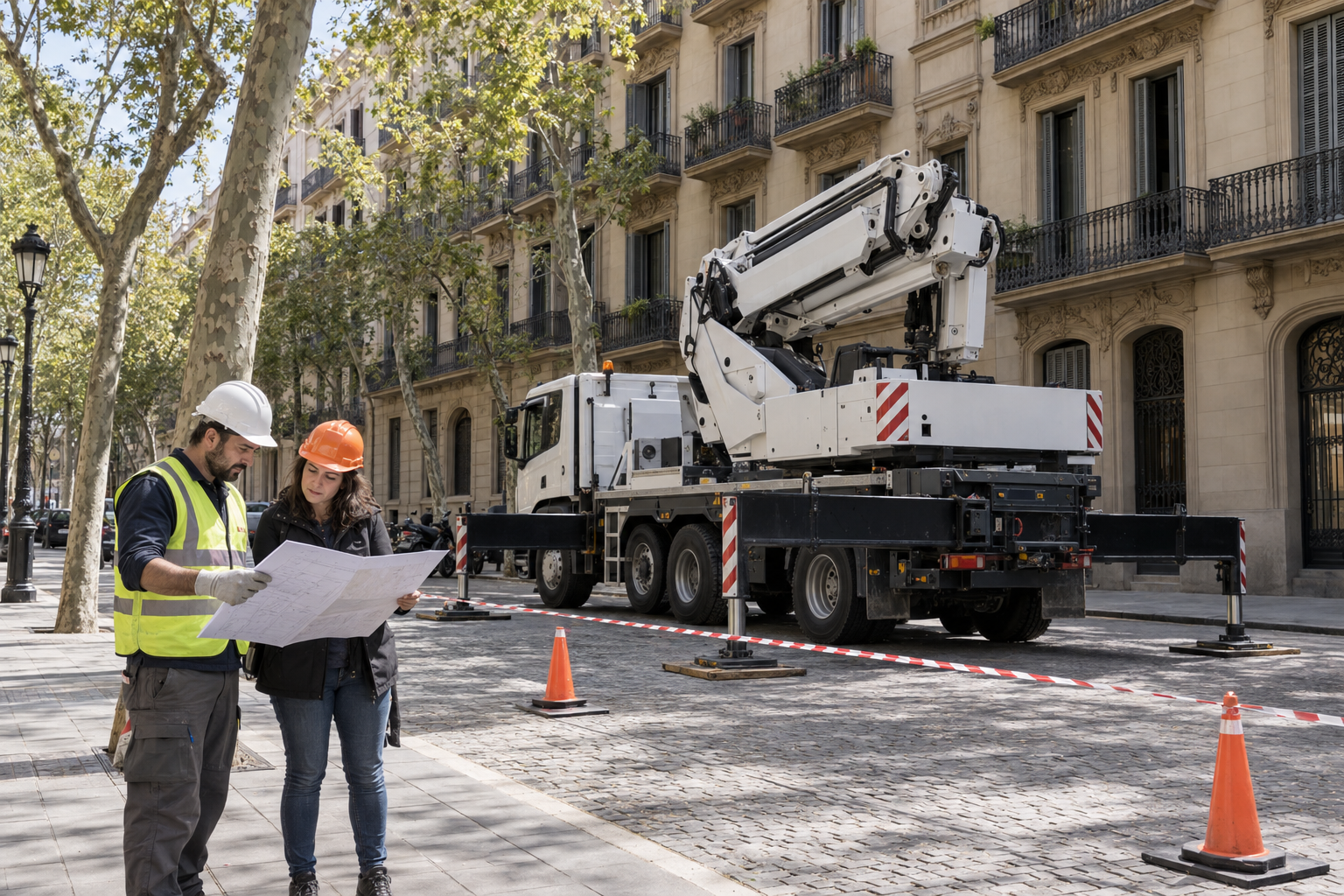
Permits and regulations for a crane truck on the street in Barcelona: what to file before the lift
Why this matters before asking for a quote
Most crane truck quotes are requested with the assumption that “the day of the lift will sort itself out”. In Barcelona that usually means a date that slips, a fee that was not on the original estimate, and, in the worst case, a vehicle that cannot work during the allowed time window. If you know the regulatory framework before locking in a date and price, the quote stops being a number with asterisks.
That is why this article focuses on what surrounds the lift itself: the municipal public-road occupation permit, coordination with the local police, the low-emission zone, and realistic lead times. This is not a legal text: it is a practical guide so that the conversation with the company running the lift starts with the information you already have.
What to know about municipal regulations
The Barcelona City Council regulates public-road occupation for works involving special vehicles through the municipal Ordinance on pedestrian and vehicle traffic. For a crane truck that needs to park with outriggers deployed, anchor jacks or block part of the carriageway, three different layers intersect:
- Public-road occupation permit (OVP). Filed by the applicant (the client or the company on the client’s behalf) and it physically authorises placing the vehicle and the auxiliary equipment on the street. The fee depends on duration and on the occupied area and it is processed through the City Council electronic office.
- Traffic and road closures. If the lift requires closing a lane, moving traffic lights or relocating vehicles, coordination with the Guardia Urbana (local police) is required.
- Itinerary of the special vehicle. When the truck exceeds ordinary weight or dimensions, the Catalan Traffic Service (SCT) issues a special circulation authorisation covering the road journey.
In practice, these three permits are requested and answered on different timelines. That is why, when the lift is on a public road, the final date is not confirmed until all three are in place.
Public-road occupation and the low-emission zone in Barcelona
The low-emission zone (ZBE Rondas BCN) affects vehicles driving on the rondas and across a large part of the municipality. For a crane truck it matters at two points:
- Access to the job site. If the route crosses the ZBE, you must check the vehicle’s environmental label and, if it does not qualify, plan a time window in which access is allowed or a different route.
- Stay on the public road. Even if the truck arrives and leaves quickly, the outriggers and the perimeter tape take up public space, and that is where the OVP kick in.
As a working rule — not a promise — large-tonnage mobile cranes usually operate at night (22:00–06:00) or on public holidays in restricted zones. That does not mean the permit is always granted: it means that, if the street and the building allow it, that window makes approval easier. The final decision rests with the City Council’s Mobility Department.
Coordinating with the local police and other services
When the lift closes a lane or affects a bus stop, a container or a permanent driveway, the Guardia Urbana steps in to validate the operation. In some cases it assigns a police escort or schedules short, agent-managed closures. The cost and coordination of that escort are discussed before the vehicle is confirmed, because they shape the time window.
There is also coordination with the building itself when the lift goes through the façade or an inner courtyard: concierge, owners’ association, and so on. This side is not in the regulation text, but it is what most often delays the operation when it is left for the day of the lift.
Lead times, fees and typical paperwork
As a working reference, the lead times that matter most are:
- OVP permit at the City Council: usually requires several working days, and the procedures portal itself indicates a minimum of 10 working days for public-road occupation as guidance.
- SCT authorisation for special transports: it depends on the route, but it usually takes at least a week to process.
- Guardia Urbana coordination: usually confirmed after the OVP is in place.
The typical paperwork prepared with the client includes a plan or photo of the surroundings, the occupied area, expected duration, an on-site contact and the operator’s public liability insurance.
What the client prepares and what the company handles
A clear split of tasks prevents mistakes. In most cases:
- Client: ownership of the space (community, commercial unit, private), photo of the surroundings, contact for the concierge or the community president, internal authorisation when needed.
- Crane truck company: drafting the lift plan, filing the OVP on the client’s behalf if delegated, coordinating with the Guardia Urbana, scheduling the vehicle and the operators.
This split is set out in the first conversation. If the client prefers to file the OVP themselves, the company supplies the technical paperwork needed.
Common mistakes that stall the lift
The three we see most often:
- Asking for a crane truck “for tomorrow”. Without an OVP and prior coordination, there is no legal way to start.
- Assuming one permit covers everything. OVP, traffic and ZBE are different layers.
- Forgetting the owners’ association. Even with a valid municipal permit, the building can refuse access through the façade or the courtyard.
Frequently asked questions
Who pays the municipal fee?
Usually the applicant. In most cases it is passed on to the end client as part of the service; it should be stated in the quote.
Can I file the permit myself?
Yes. If the company provides the technical paperwork, the applicant can file the OVP directly through the City Council electronic office.
What happens if the street does not allow a lane closure?
The lift is replanned: night shift, weekend, or a smaller crane that does not need a closure. If none of those works, the date is changed.
Does the ZBE affect me if the truck enters and leaves several times?
Yes, if the vehicle does not carry an allowed environmental label. Check the label and, if it does not qualify, plan routes or time windows that avoid the restricted area.
Does the Guardia Urbana charge for escorting the lift?
In some cases a fee applies; in others the agents are present at no direct cost. It is confirmed during coordination.
How to contact us
If you have a public-road lift planned and are not sure where to start with the permits, send us the exact address, a photo of the surroundings and a target date. We review the case and let you know whether the operation is workable in that window, which permits need to be filed and which paperwork you should prepare.
More information on our crane services and transport services. To discuss your case: contact.