

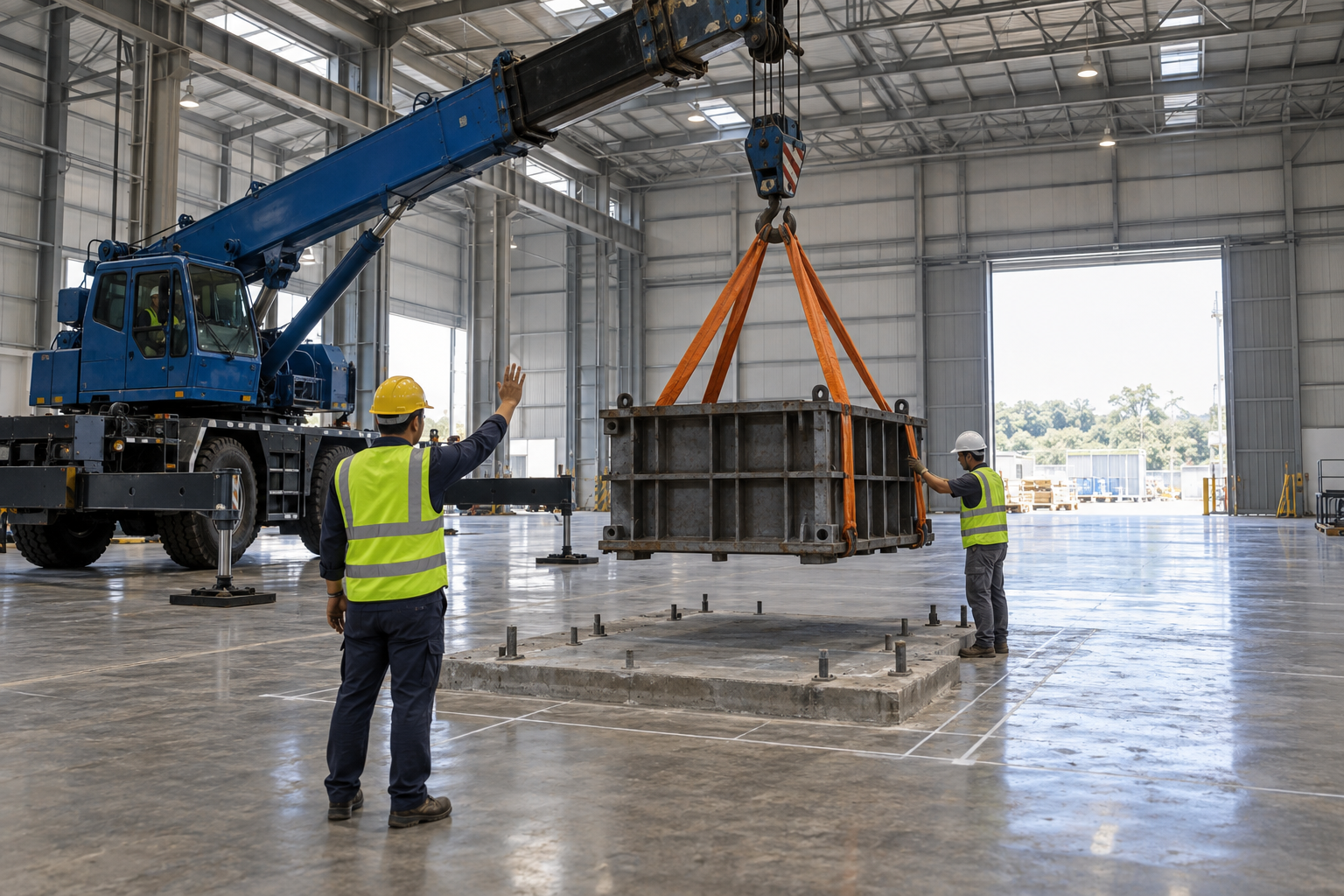
Crane truck lifts in industrial estates and warehouses: how to unload and position machinery on the shop floor
Why an industrial-estate lift needs twice the planning of a street lift
On an industrial estate the lift starts before the truck arrives. The warehouse has its own rules: sliding doors with limited clearance, a floor that may or may not take the outrigger load, narrow aisles to the final base, parallel activity on lines that cannot stop. If the lift is planned as if it were a street job, the truck arrives, deploys the jacks and a problem that was already on the plan shows up.
That is why, for this kind of service, we ask for a simple warehouse plan, a photo of the base and a photo of the door before confirming the vehicle. With that information we decide the crane, the outrigger position and the unloading and positioning sequence for a single morning.
Before entering: access, clearances and warehouse doors
The route to the warehouse door is the first part of the work. The points to check are:
- Width and height of the estate’s internal road: some estates have generous road widths but overhead crossings or pipes that cap the vertical clearance.
- Turning radii at junctions and access points: an articulated truck needs more room than it looks on a plan.
- Ground condition on the last stretch: asphalt, concrete, cobblestone or soil. That decides whether spreader plates are placed under the outriggers.
- Type of warehouse door: sliding, swing-up, fast sectional. The clear height decides whether the truck enters or the lift is done from outside with the boom extended.
If the lift combines unloading and on-floor positioning, the interior height and the distance between columns are also reviewed. With those data points we decide whether the truck stays at the door or comes inside.
In the yard: outriggers, slewing room and crew
In the warehouse yard, the truck deploys its outriggers onto a prepared surface. This is the trickiest phase when the ground is not clean asphalt: that is where spreader plates come in, and where a soft surface needs an extra mat. The jack position is decided from the plan and from what is seen on site, because there is almost always a drain, a manhole or an electrical line that nobody had marked.
The minimum crew for a safe lift:
- Crane operator, who runs the operation and signs the job sheet.
- One person on the shop floor who knows the base and the final position of the equipment.
- One person on the ground who secures the load with straps or chains and removes the slings once the load is resting.
If the yard is shared with other businesses or has pedestrian traffic, the working area is fenced off with perimeter tape.
Inside the warehouse: final positioning, bases and chocks
When the lift finishes inside the warehouse, what the crane truck delivers is the load resting on its final base. What is not included is alignment, levelling, electrical, pneumatic or hydraulic connection or commissioning. Those tasks are carried out by the plant’s own technical team or by the installer.
Before entering the warehouse, the following must be clear:
- The base is cured, clean and at the right level. If not, the lift is paused until it is.
- There is enough room to position the equipment and to open the truck’s jacks inside the warehouse without stepping on sensitive areas.
- A plant operator is on hand to receive the equipment and give the final “OK” once it is resting.
For heavy machinery (presses, machine heads, moulds) the crane truck coordinates with the installer to leave the part in the position and orientation the plant needs for its later assembly.
Typical machinery: presses, moulds, lines and cabins
On industrial estates in Barcelona and its area (Zona Franca, Sant Ermengol, El Port, Rebató) the most common moves are:
- Mechanical or hydraulic presses entering or leaving the shop floor.
- Injection or stamping moulds replaced during a weekend stop.
- Paint booths or sound-proofed cabins.
- Line heads and conveyors.
- Generation or industrial HVAC equipment with a prepared base.
Each case changes the weight, the centre of gravity and the lifting point. That is why the plan and the photos taken beforehand save time on the day: they let the sling and the pick angle be decided before moving the crane.
Coordinating with plant activity
When the warehouse is in production, the lift runs in a low-activity window. The usual approach is to coordinate with the plant manager so that the working area is cleared, adjacent lines are stopped and staff are informed. If the lift occupies aisles, the diversion is signposted in advance.
If the lift coincides with a shift change, the area stays roped off until the crane leaves the warehouse. That keeps any operator out of the boom’s slewing arc.
What to prepare so the unload fits into a single morning
What we ask the plant for before the lift:
- Plan or sketch of the warehouse with the base marked and the access door.
- A recent photo of the base and of the door.
- Weight and dimensions of the equipment, and the centre of gravity if known.
- Planned lifting point or, if there is none, a note to define it with the client.
- Plant contact person and phone.
- Preferred time window and constraints (scheduled stop, weekend, public holiday).
With that, the lift closes out in a single morning. Without it, the work is improvised and stops appear that cost more than the crane itself.
Frequently asked questions
Can you bring an articulated boom into narrow aisles?
It depends on the clearance. In warehouses with aisles narrower than 3.5 m a smaller crane is usually needed, or the lift is done from the door rather than from inside.
Can the outrigger be placed on the warehouse floor?
Only if the floor is rated for the point load. Standard industrial slabs usually accept it with a spreader plate, but it must be confirmed with the property.
What do we need to move a press?
Weight and dimensions, lifting point, plan to the base and a stop window for the adjacent line. Without that information the vehicle is not confirmed.
Does the crane truck work on public holidays?
Yes, as long as the warehouse and the estate allow access. Public-holiday work is usually the cleanest option when the plant is on a scheduled stop.
Does the service include installing the equipment?
No. The crane truck delivers the load resting on its final position. Alignment, connections and commissioning are the plant’s or the installer’s responsibility.
How to contact us
If you have a lift planned in an industrial-estate warehouse, send us a plan or sketch with the base marked, a photo of the door and the equipment weight. We review the operation, confirm the vehicle and the time window, and coordinate with the plant manager on the day of the lift.
More information on our crane services and transport services. To discuss your case: contact.