

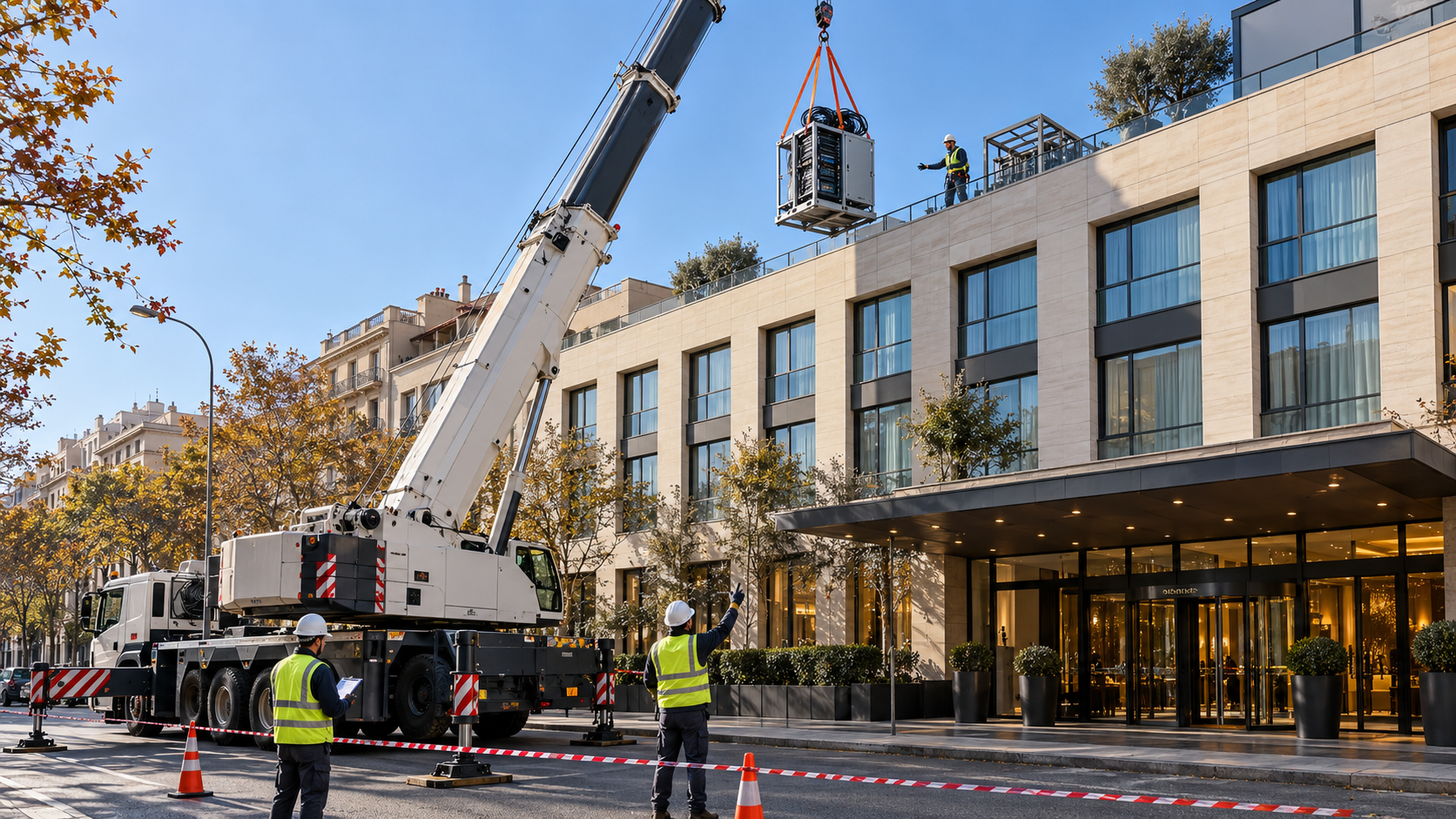
Lifting technical equipment to a rooftop with a crane truck in Barcelona: hotels, events and telecommunications
Why a technical rooftop needs more planning than a residential terrace
A technical rooftop is not a place to hang laundry. On the rooftop you find equipment that serves the whole building: telecoms antennas, outdoor racks, central HVAC, rooftop AV gear, extraction units, auxiliary tanks. When one of those pieces enters for the first time, is replaced or is repositioned, the crane truck works against a real facade, with a real load, on a building that does not stop. If on the day of the lift it turns out that the rooftop does not accept a concentrated load, or that the facade has awnings or services that were not on the plan, the morning is lost.
That is why, for this kind of service, we usually ask the client for three things before confirming the vehicle: a sketch or plan of the rooftop with the final location of the equipment, a recent photo of the facade where the load will enter, and the weight and dimensions of the equipment. With that we decide the vehicle, the boom length, the boom position and whether the lift runs from the street or from the inner courtyard.
What changes when the building is a hotel or an event venue
In a hotel or an event venue the lift intersects the building’s operations. Rooms are occupied, events are running, guests are on the rooftop terrace or in the lobby. That changes three things:
- Operating window. The lift is scheduled in a window when there are no events, no group arrivals and no room service on the facade where the load enters.
- Truck access. The crane truck enters the hotel street, not an industrial yard. That requires a parking reservation, perimeter tape and cones, and notice to the concierge.
- Guest image. The taped-off area stays visible at the entrance. We usually recommend opaque hoarding around the zone and a single controlled crossing for guests and staff.
Hotel service lifts are also coordinated: if the load is close to the service lift’s limit, that route is discarded and the boom-from-facade route is used.
Telecommunications and antennas: weight, wind and building permits
When the equipment is an antenna, an RRU, an outdoor rack or a small mast, the constraints are three:
- Wind. Above moderate gusts the lift is paused. We ask the client for a wind reading on the rooftop and we schedule a window with margin.
- Internal building permit. The telecoms operator needs authorisation from the owner or the owners’ association to install on the rooftop. Without that, the lift does not run.
The crane truck covers the lift and the positioning, but NOT the equipment hook-up, the commissioning or the legalisation with the relevant national telecoms authority. Those are the operator’s tasks.
AV and production equipment on the rooftop
In event venues, hotel terraces and rooftops with cultural or sports programming, the typical lift is production gear: LED screens, truss motors, stage structures, soundproofed auxiliary generators, speaker stacks. The challenge here is:
- Timing. Production usually only has the rooftop free during the change between events. The lift window is hours, not days.
- Distributed load. A large LED screen or a truss weighs more than it looks and is shared across several lift points. It is planned with the structure plan and the actual weight per point.
- Coordination with production. The event’s production manager must be present, give the final “OK” and sign the lift sheet.
The usual sequence: the truck arrives at the start of the change-over, deploys, lifts the gear in mounting order and retracts before the next event arrives. If something does not fit, the order is replanned.
Truck access to the street, facade and regulation
When the crane truck works on a public street in Barcelona, the same fronts appear as in any urban lift: parking reservation, public-road occupation if the tape invades the pavement, coordination with the local police if the boom invades the carriageway, and checking the vehicle’s environmental label against the ZBE Rondas BCN low-emission zone if the route crosses the restricted area.
On rooftops, we additionally confirm that the facade does not have awnings, gutters, exposed electrical services or anchored planters that the boom could brush. If any are present, they are removed before the day and put back after.
Coordinating with the owners’ association and the building operator
The owners’ association or the building operator decides whether the lift runs through the facade, the inner courtyard or the skylight. That decision is taken at the first conversation, not on lift day. If the facade is protected or the courtyard cannot take the boom, the operation is replanned and, in some cases, a smaller crane operating from inside the courtyard is chosen.
The building staff is also coordinated: concierge, security, maintenance. The contact person at the building must be reachable throughout the lift.
Lead times, operating windows and prior checks
Lead times we see in practice:
- Vehicle confirmation: one or two days after the plan, photo and weight are received.
- Operating window: usually coordinated a week ahead when a hotel or event is involved; less when an industrial client is on a scheduled stop.
- Internal building permit: confirmed before the date is locked in. Without that, the lift does not run.
The prior check includes, at least: rooftop plan, equipment weight and dimensions, lift point, photo of the access area and of the facade where the load enters, contact person and preferred time window.
Common mistakes we see on rooftops
Three that come up again and again:
- Asking for the lift “for tomorrow” with no plan or weight for the equipment. Without that information the vehicle is not confirmed.
- Assuming the rooftop accepts the load. Not every rooftop slab is rated for machinery. If it is not, the operation is replanned or paused.
- Forgetting the building operator or the owners’ association. Even with a valid municipal permit, the building can refuse access through the facade or the courtyard.
Frequently asked questions
Can the lift run in wind?
Above moderate gusts the lift is paused. We ask for a rooftop wind reading and we work with margin.
What happens if the rooftop does not accept a concentrated load?
The lift is paused and an alternative is proposed: support on the existing structure, a different rooftop location, or a smaller crane operating from inside the courtyard.
Who files the municipal permit?
Usually the crane truck company if the client delegates. Coordination with the building owner is independent and is closed by the client.
Can we use the building’s service lift for the equipment?
No. Only if the weight and dimensions fit within the service lift and the dimensions work with the headroom. In older hotels it is usually ruled out by capacity.
Does the service include fixing to the rooftop structure?
No. The crane truck delivers the equipment resting on its final position. Mechanical, electrical and telecoms fixing are the installer’s or operator’s responsibility.
How to contact us
If you have a rooftop lift planned and are not sure where to start, send us the rooftop plan or sketch, a recent photo of the facade where the load will enter and the equipment weight and dimensions. We review the case, confirm the vehicle and the window, and coordinate with the building owner on lift day.
More information on our crane services and transport services. To discuss your case: contact.