

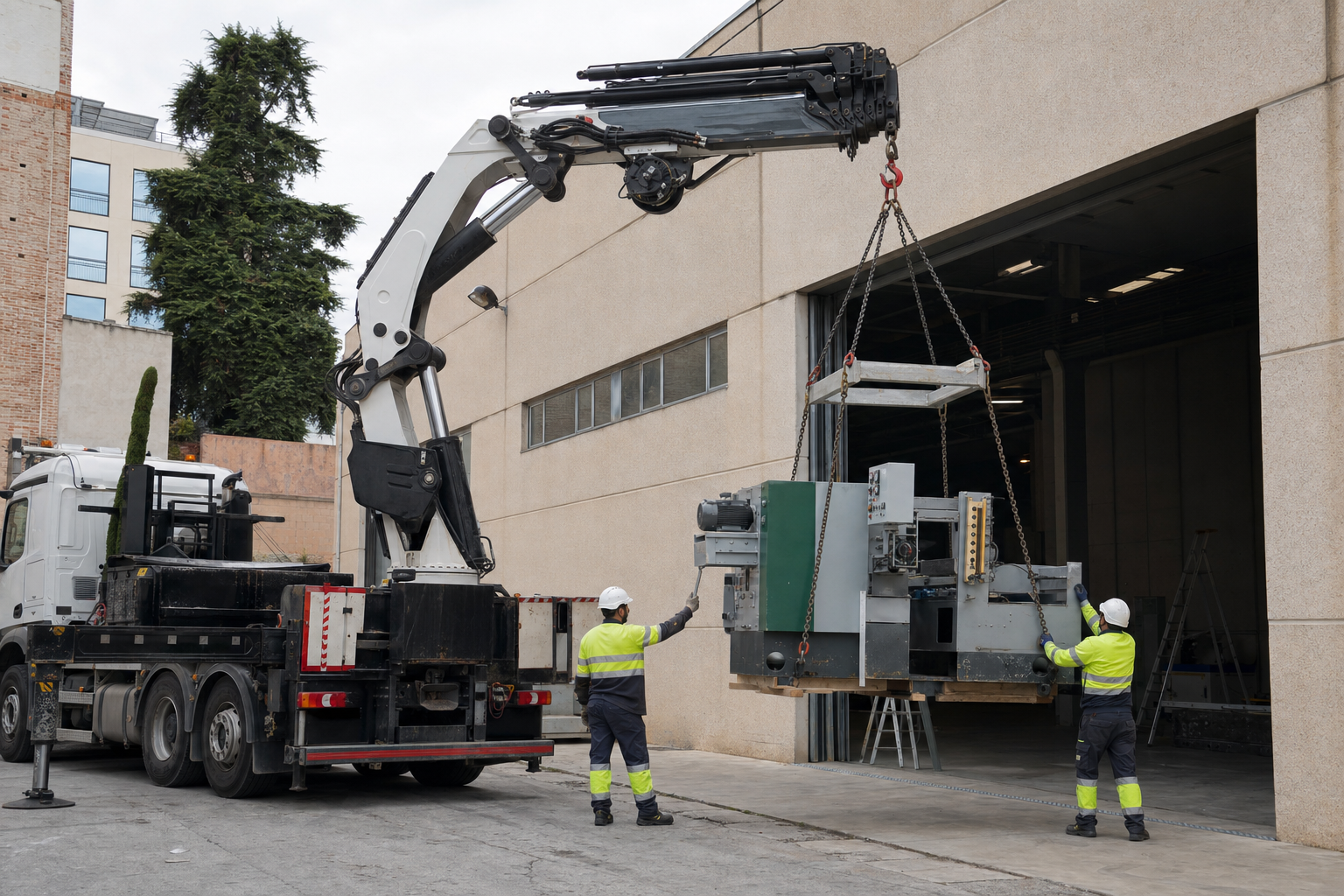
Crane truck for office and retail fit-outs in Barcelona: what to lift, what to remove and what to leave alone
Why a crane shows up in most serious fit-outs
In an office or retail fit-out, there is a moment when the work stalls: a three-metre counter has to be lifted, a full glass partition removed, a heavy server pulled out through a window, or a glass panel installed on the first floor. The internal service lift cannot reach, the passenger lift is too small, the staircase is too narrow and moving by hand is slow, expensive and risky.
That is when the crane truck comes in. Used well, it sorts in a single morning what would otherwise be days of work with people in the street and damage risk. Used badly, it becomes an extra cost and a permit problem. This guide explains when it adds value, when it gets in the way, and how to coordinate it with the site team.
What gets lifted and removed with a crane in a fit-out
In offices and retail spaces in Barcelona, the most common crane truck maneuvers are:
- Lifting glass, glass partitions and enclosures.
- Moving counters, point-of-sale units and custom furniture in and out.
- Placing light HVAC equipment on the rooftop or in the technical room.
- Removing old equipment: servers, electrical cabinets, industrial kitchen equipment, large fridges.
- Lowering demolition material into a container on the street.
- Lifting prefabricated elements: prefab bathrooms, kitchen modules, technical cabins.
In every case, the decision to use the crane truck or the internal service lift depends on weight, bulk and, most of all, the route between the street and the final point.
When it is worth calling the crane
A crane truck is clearly worth it when:
- The item weighs more than 200 kg or is bulky even if it weighs less.
- The building lift or service lift cannot take the piece in size or weight.
- The access goes through the facade, an interior patio or a window, not a door.
- The job has to be done in a very narrow time window to avoid disturbing the rest of the building.
- The material is high value and damage costs more than the maneuver.
- The fit-out requires paperwork for the project manager or the owner.
In these cases the crane pays for itself in hours of work saved, in lower risk and in fewer breakages.
When the crane is not needed
There are also scenarios where the crane is overkill:
- Standard modular furniture that fits in the lift.
- Removing small material in bags or boxes via the staircase.
- Moving things within the same floor without going through the facade.
- Any maneuver where the cost of setting up the lifting kit exceeds the real saving.
Forcing a crane in these cases only adds cost and permits that nobody needs. A good coordination with the provider starts with saying “in this line item, no crane”.
How it is coordinated with the site team
A crane maneuver runs in parallel with the general schedule. To keep it from breaking the rest of the fit-out:
- The site manager sets the date and the time window.
- The provider visits the site or receives a pack with plans and photos.
- Anchor points, street access and safety zones are agreed.
- If the maneuver affects the sidewalk or the road, municipal permits are requested in advance.
- On the day, the operator coordinates with the site manager and the installer at the offload point.
- An operation report or photos are delivered to the project manager.
When these six steps are clear, the crane feels like one more part of the schedule, not an unexpected extra.
Minimum information to ask for a serious quote
Before asking for a quote, it helps to have ready:
- Exact address and, if available, the floor plan.
- Photos of the access, the interior patio or the facade through which the piece will enter.
- Weight and dimensions of each item.
- Floor plan of the building and the height to clear.
- Schedule allowed by the owner or the community of owners.
- Whether the street has to be closed or only the sidewalk.
With that information, the provider can quote without surprises and the price reflects the real cost. Without it, you get open ranges that almost always get more expensive once the team is on site.
The special case of glass and partitions
Glass and glass partitions are, by far, the elements most likely to break in a fit-out if they are not handled with a crane and proper suction cups. Some basic rules:
- Glass must always travel in a certified frame or suction rig.
- The crane has to be able to approach the facade at the right boom angle.
- The floor and the frames must be protected during the lift.
- The glazier has to be on site at the moment of offload, not after.
- The street access has to be clear of cars and obstacles.
A single break of a large partition costs more than the whole maneuver. That is why glass is the textbook case for using a crane.
Frequently asked questions
Do I need a municipal permit to use a crane in a fit-out?
If the maneuver affects the sidewalk, takes up a parking space or closes a lane, yes. The provider usually handles the paperwork, but it has to be requested several days in advance.
Can the crane reach an interior courtyard?
It depends on the width of the passage and the height. In narrow courtyards, a smaller crane with a shorter boom is sometimes used. The provider assesses this on a site visit.
What if the fit-out runs during office hours?
It can, but the community of owners and the owner have to be informed, and in many cases the work has to happen during the quietest hours. Coordination with the rest of the building is key.
Can the crane also be used to lower demolition waste?
Yes. The same maneuver can combine lifting new material and lowering debris to a container, which reduces the overall cost.
How this fits with the rest of the project
The crane truck in a fit-out is not a resource to use by default, nor to discard by default. It is a specific tool reserved for the moments when the piece and the building demand it. When it is planned from the start, it slots into the schedule and the budget. When it is decided at the last minute, the extra cost and the delay both show.
That is why the practical recommendation is to include the lifting line in the fit-out budget from the first version, even with an estimated figure. It is then firmed up once the materials and plans are closed. That way you avoid the improvised decisions that end up costing more.
Bottom line
In an office or retail fit-out in Barcelona, the crane truck cleanly handles the moves that do not fit in the lift or the staircase. It works very well for glass, partitions, counters, equipment and the removal of bulky items. It works badly when it is forced onto pieces that go through other routes. The key is to plan the maneuver with the rest of the fit-out and keep the coordination with the provider and the project manager in writing.